Blog

Four tips to help you if you’re struggling

It’s men’s health week and this year the week is largely focusing on numbers – numbers and statistics that they believe all men need to know. These include facts such as men needing at least 150 minutes of exercise per week and that they shouldn’t consume more than 14 units of alcohol every week. You may already know these numbers, but you might not know that 75% of all suicides are by men.

Suicide is often a taboo subject, especially for men. We’re here to break that stigma. If you’re struggling with your mental health, talking about it can be the first big step to getting the right help. We’ve got some tips for what to do when you’re struggling.

1. Open up to someone

Whether it is a friend, family member, GP or someone on an online self-help forum, opening up to someone can often help lift a weight off your shoulders. Letting someone know you’re not feeling quite right also means they can look out for you and check up on you every now and again.

2. Be kind to yourself

Getting the right help for your mental health isn’t as straight forward as a course of antibiotics and will often need time to start getting better. Being kind to yourself while you’re not feeling great is an important step that makes you aware that you’re not alone and that you deserve to get help.

3. Do the things you normally would

Mental health problems can often have an impact on your physical health and make you not want to do the activities you’d normally enjoy. If playing a sport or seeing a friend is something you’d ordinarily do and makes you feel good, try and take part. Getting out and doing things you enjoy is a great way to distract your mind.

4. Don’t be ashamed to seek help

Recognising and asking for help is never easy but it is the right thing to do. Suffering in silence means you won’t get the help you need. Asking for help doesn’t make you weak and isn’t something to be embarrassed of.

If you need urgent help, you can call the Samaritans at any time of the day on 116 123. They’re available around the clock, seven days a week. If you’re experiencing thoughts about self-harm and suicide, visit your local A&E or call 999.


strip

“A lot of macho, keep your head down and march on.”

Did you know that suicide is the biggest killer of men up to the age of 49 in the UK? In his blog, Suffolk-born military intelligence analyst Joe Tyrrell talks about his struggles with mental health while being in the army. ​

“There’s a certain perception of being in the military. It’s a male-dominated industry in which you are expected to be in peak physical and mental condition at all times.

“It never occurred to me for a second that I would become victim to mental health issues.

“In all honesty, I never really understood it. I’d had a few friends go through some awful periods of low moods and I always tried to be supportive.

“It was just never something I thought would happen to me.

“I’d always assumed that mental health issues only came about if something tragic happened, but I realise now this isn’t the case.

“Last year, I obtained a pretty serious injury to my ankle which prevented me from doing any exercise. As someone who was in peak physical condition, I gained weight quickly and things went into a downward spiral from there.

“Not being able to do my job as well as I could started to affect me and I began to have some horrible thoughts in my head.

“I thought I was worthless and a burden. I never spoke up because I thought I was being over-dramatic. I couldn’t sleep – I’d maybe get 1-2 hours a night for weeks and I stopped taking care of myself.

“I completely shut down. I made silly mistakes at work – and these mistakes only added to the reasons I thought I was absolutely worthless.

“It wasn’t until my sister asked me what was wrong that I actually talked about what was going on. She helped me write a letter to my boss and I got booked in to see a doctor the very next day.

“The initial appointment was tough. I went back to my room and cried for two hours – I’d been diagnosed with major depressive disorder, anxiety and insomnia.

“I was the lowest I’d ever been.

“At that point I wrote a note, telling my loved ones how much they meant to me and apologising for what I was about to do.

“As if by some sign, I’d written this note on the back of a mental health support pamphlet I had been given at the appointment. I rang the 24/7 support number.

“A lot has changed since that call – nine months of stuff to be precise.

“The army were absolutely incredible in getting me the support I needed. The treatment and the understanding I received from them was amazing.

“I’m on medication – they’re not magical but they are really working for me. I’m in such a better place I can’t even describe it.

“Did you know men are three times for likely to take their own life? I nearly became a part of this statistic.

“Lads – we need to talk.

“I’m speaking up because we need to break this stigma of ‘manning up’ and being ‘tough’ as a man. In the army especially, where there’s a lot of the macho, keep your head down and march on kind of mentality.

“Talk to anyone. Just make sure you speak up. Break the stigma.”

If you need support, you can contact the Samaritans 24/7 on 116 123 or CALM on 0800 58 58 58 from 5pm – midnight (this service is aimed at men aged 15 – 35.

strip

Chat with Charlie one year on

Mental Health Awareness Week in 2019 marks one year since Chat with Charlie expanded to a seven day-a-week service.

Chat with Charlie, an online mental health service based at the offices of Mid and North East Essex Mind, is open to all students who study at the University of Essex. It offers a platform in which students are able to chat anonymously to trained volunteers via an online chatroom.

The service was initially launched as three days a week on the first anniversary of Charlie’s death. The response was phenomenal and showed that there was a need for an anonymous platform where young people can safely talk about their troubles without judgement.

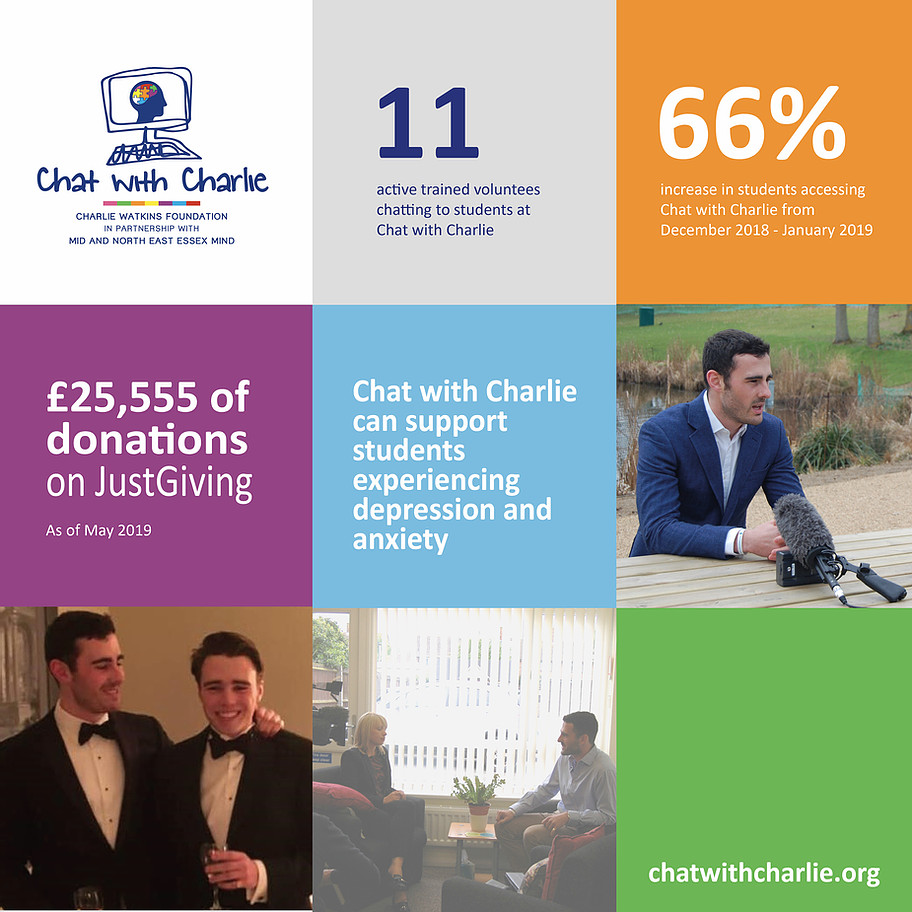
To mark the achievement the Charlie Watkins Foundation (CWF), Mid and North East Essex Mind and the University of Essex has achieved since Chat with Charlie became a seven-day service, CWF has put together the below infographic.

The key statistic on this infographic shows that there was a 66% increase in students accessing the service from December 2018 – January 2019. It is a remarkable achievement showing that the service has been beneficial to students, particularly those suffering with depression and anxiety.

Thanks to the Essex Community Foundation and Mid and North East Essex Mind, CWF is now in a position where the service being rolled out nationwide is becoming a possibility.

It is because of the generous donations on the Charlie Watkins Foundation’s JustGiving page that this been possible. An amazing £25,555 has been raised from friends and family of the foundation.

The foundation also has some amazing volunteers who go out and do some incredible work to raise money. 

The foundation would like to thank everyone who has been involved since its inception. It’s a huge achievement to have Chat with Charlie as a legacy to Charlie and if just one person is helped, it has all been worth it.

strip

An insight into the toughest non-stop kayaking marathon in the world

Two friends have taken part in a 125-mile long kayaking marathon for two charities very close to their hearts.

Oliver Ainsworth and Matthew Hague took part in the Devizes to Westminster Canoe Race, dubbed the toughest non-stop kayaking marathon in the world lasting between 24-27 hours, last month.

A target of £5,000 was set for the event, with any donations coming through to be split evenly between the Suffolk Community Foundation and the Essex Community Foundation (who manage the Charlie Watkins Foundation’s finances). Oliver had been life-long friends with Charlie Watkins before his untimely death in 2017.

Now recovered from his rowing exerts, Oliver has given us a snippet of the experience:

“Saturday for us and the support crew started at 0400 – so not very enjoyable.

“We got onto the water and started our epic paddle at 0658 with sun in our eyes and looking forward to getting one heck of a sun tan!

“Throughout the day we made good progress and even with 29C recorded in Newbury, we managed not to go down with heat-stroke and crack on.

“70 miles in and the night took hold. Temperatures plummeted to zero and it all became rather uncomfortable.

“Exhaustion, fatigue and the cold and wet conditions took effect which made the night paddling rather painful.

“Navigating the larger parts of the Thames became rather difficult with fog rolling on the water so all in all, it was not as enjoyable as the day-time paddling.

“At 0520, the light started to come back and with five miles to Teddington, we knew we had roughly 21 miles left before finishing.

“We met our amazing support crew at Teddington which is the final lock – we took on food and water, were given some emergency supplies and set off for the final 17 miles of the race along the Tidal Thames.

“A rather painful and lonely two hours later and we entered the centre of London and, shortly after, we could see our goal of Westminster Bridge and FINALLY… finally, at 0920, finished.

“Totally exhausted and broken we had accomplished our goal.” This year’s race was dubbed one of the hardest in its 71-year long history due to the high day-time temperatures.

And, out of the 145 boats that started the race, 31 did not finish. Oliver and Matthew’s final position was 77th out of 114 with a time of 26 hours and 20 minutes – a phenomenal achievement.

The pair are incredibly close to their £5,000 target. Please give generously and help them hit their milestone.

strip

Five common causes of stress

Are you someone who gets stressed easily? You are not alone. Feelings of stress can be triggered by all sorts of things that are happening in your life. It doesn’t matter how big an event is – the smallest thing can overwhelm you so you should never be afraid to seek help if you are feeling the strain. We have compiled a list of five common causes of stress with help from Mind.

1. Lack of control

A lack of control in any environment can cause a lot of stress. There are many reasons why a situation might be out of your hands which can make you feel helpless. Sometimes, there is nothing you can do apart from ‘ride it out’. But if you are feeling the effects of something beyond your control, make sure you confide in someone. Especially if they can help alleviate those feelings.

2. Having too much to do

Having too much to do can be very common in the workplace. Being in a fast-paced environment can be stressful for anyone to deal with and tight deadlines can make this a lot worse. Just remember that your mental health always comes first so, if you feel overwhelmed, speak to your line manager or someone from human resources in your workplace.

3. Not having enough to do

As well as being stressed from having too many responsibilities, you can also feel the pressure from not having enough to do. Times like this can occur during your job if you are having a particularly slow day and have already finished your work. These feelings are heightened if you don’t have many hobbies in your free time. You should try and find an activity you can do out of work such as reading or going for a run. Not only will these keep your brain active, they can also relieve symptoms of stress.

4. Your perception of a situation

Depending on your mentality, the way you perceive a situation might make you more stressed than others in your position. This can depend on several factors such as your self-esteem or how you process information. There is no wrong or right answer with how you look at something, but if you are someone that tends to see the negative side, you should always find someone to talk to about it.

5. Worrying about something

Being worried about something can be incredibly stressful. Much the same as the point above, if you are someone who perceives something in a certain way, you can struggle with worry more than others. You should always remember that no matter how big or small a problem might seem, your feelings speak louder than words. If you feel that your worry over something is causing you more stress than you can handle, you should make sure someone knows how you feel.

strip

We need to talk about mental health at university

More and more universities are appearing in the news with issues regarding mental health.

The most recent being the University of East Anglia (UEA), which revealed that ‘mental health improvements [were] needed’ after four students had taken their lives on campus since May.

UEA’s student union have now started drafting its first mental health manifesto after the fourth death occurred earlier in March.

But more needs to be done.

Why is mental health such an issue at university?

For many new students, this is the first time that they have lived away from home. As well as this, many students choose universities quite far away from their home towns.

This can prove quite detrimental to certain students. While many adapt to living independently like a duck to water, some can really struggle with the notion of not having their support network around them anymore.

This can cause new students to become isolated and lonely which can result in them experiencing mental health issues such as depression or anxiety.

How does it affect education?

If students withdraw into themselves because of mental health, it can be harmful to their education.

If a student has not made many friends, they may not have anybody checking up on them to see if they have been attending their lessons. When you are in a bad frame of mind, it can be hard to find the motivation to get up for lectures.

How can it be improved?

While there are many universities that provide mental health support, it is often the case that students feel embarrassed or even ashamed to seek help.

To help combat this, services that offer anonymity could be useful for those who do not wish to be named when asking for help.

This is why the Charlie Watkins Foundation set up Chat with Charlie, an anonymous 1:1 platform in which students can speak to trained volunteers if they are struggling.

It is currently only available at the University of Essex but it is the foundation’s dream to roll this out to universities nationwide.

If you want to help, you can donate to the foundation’s JustGiving page.

There is so much more that needs to be done for students at university who might be struggling with their mental health. But it is the foundation’s hope that Chat with Charlie paves the way for others to make a difference.

strip
Charlie Watkins Foundation - about us

NEWS: Brother’s open letter to late twin calls for more to be done about men’s mental health

An open letter from the twin brother of a man who took his own life two years ago today has called for more to be done with regards to mental health in young people, in particular men.

Harry Watkins, whose brother Charlie was only 22 when he died, wrote the letter to mark the two-year anniversary of his brother’s passing.

The letter details Charlie’s “bravery” at fighting his mental health battle alone and how he “took for granted the bond [they] shared.”

Essex-born Charlie Watkins took his life after a battle with mental health that spanned many years.

Harry and Charlie tragically lost their mother to cancer at nine years of age and it is thought that Charlie never fully recovered from the loss.

The letter reads as follows:

Dear Charlie,

It feels strange to write a letter to you now, although it is somewhat therapeutic. I used to think that I knew what you were thinking, yet it is clear to me now that I never truly knew. It is obvious that I did not know of the demons you were battling in your head, or what you were forced to do next.

It has been two years since the saddest day of my life. The day I will never forget, chiselled in my mind like a mason takes to stone, and there it will remain. It serves me not as an infliction of pain, but as a reminder of the work I have to do in your name. Even though you may no longer be with us, your name lives on. The Charlie Watkins Foundation is a symbol, for all those who struggle with the same fight which you so bravely struggled with alone, to show them that there is hope and most importantly, solace.

There is not a day that goes past where I don’t think of you. Watching films we’d seen, eating at restaurants where we’d gone to, and even going to the pub where you so often “forgot” to take your wallet. What I would give now to buy you one more pint is immeasurable.

It is not often someone at the age of 24 can say that they have lost a brother, furthermore a twin. It is a connection that is like no other. I constantly feel like there is something missing from my life. I took for granted the bond we shared. I never said I loved you enough or actually admitted you were the quite good-looking brother who had a certain way with words. I lived in awe of your speedy wit and ability to understand a joke a lot quicker than me. I still replay some of your jokes in my head, having a private laugh every now and then. To be honest, I still don’t quite understand one or two of them. Then again, we always knew who the smarter brother was.

Upon undertaking work for the Charlie Watkins Foundation, it became clear that there was a problem out there, and not a small one either. I hadn’t realised that suicide is the biggest killer of men under the age of 45. How did I not know this? I assumed it was potentially my ignorance, but upon further investigation and talking to friends I realised that they too were none the wiser. Why is there such a stigma surrounding mental health? If it was cancer or dementia, I’m sure everyone would be talking about it. This brought us, the foundation, to one of our key questions and goals. How do we get people to talk about mental health without being scared to do so? This is why we designed Chat with Charlie in your name. It is an online chat-room. A place where students can turn when they are struggling. Hopefully we will be able to spread this nationwide, helping as many as possible. If only there was something like this for you when you were suffering.

Charlie, I will never forget you but will learn to cope with living without you. I will carry your memory with me always, as I do with mum’s. I so often think about what you would be doing now. What job you would have, where you would live, and what beautiful girlfriend you would no doubt have. Sadly though, these are things I will have to leave to the imagination.

Take happiness darling brother, knowing that there is always a place in my heart for you to reside, as I know the case to be true with so many others.

I wish you eternal love and peace.

Your 10-minute younger brother,

Harry

strip

Four top tips to combat a difficult day at university

When you’re at university, especially when it’s far away from home, it can be easy to feel isolated when you’ve had a bad day. You would have most likely come to university on your own and you might not have made too many friends yet, which means your support group can’t be there for you in person.

With all this in mind, it can quickly become very hard to overcome bad days. If you’ve ever struggled with this or want to prepare yourself for the future, take a look at our top tips for combating a difficult day at university.

1. Call your family or friends

Just because they are far away doesn’t mean you can’t speak to them! Picking up the phone and calling a close friend or family member can elevate you significantly. You can always facetime or Skype if you prefer to see them too.

You can also make plans to go back home or for your friends and family to come and see you one weekend so you have something to look forward to.

2. Take some time for yourself

Taking some time for yourself gives you some much needed TLC. Think about how you usually unwind after a tough day. This could be something as simple as watching a Netflix programme or having a bath. You should take whatever time you need to destress and calm yourself down.

3. Keep a diary

It sometimes helps people to keep a log of all of their day-to-day activities in a journal or a diary. Having this means you can refer back to days where you were feeling worse and you can put things into perspective. People also find it very cathartic writing their thoughts and emotions down as once it’s written, they’ll feel as if a weight has been lifted and they can let go of their negative feelings.

4. Open up to your housemates

Don’t be afraid to tell your housemates that you’re struggling. If you haven’t mentioned your mental health before, you can always ask if you can speak to them over a coffee and let them know that you’re not feeling great. Doing this means your housemates will be aware of your moods and can check in on you when you’re not having a good day. They can also be great at cheering you up and getting you out of the house.

strip

NEWS: Local jockey rides in memory of school friend

A local jockey came second place at a racecourse on Sunday in memory of a school friend who took his own life.

Max Kendrick, who was friends with the late Charlie Watkins when they were at school, rode his horse, Chat to Charlie, at his first ever race in Cambridgeshire at Huntingdon Racecourse.

Max and his mother, Carolyn, decided to name the racehorse after an online mental health initiative created by the Charlie Watkins Foundation in conjunction with Mid and North East Essex Mind in a bid to raise awareness of platform.

The platform, Chat with Charlie, is a 1:1 platform offered to students at the University of Essex and is funded by the Charlie Watkins Foundation.

The Charlie Watkins Foundation was founded a few months after Charlie Watkins, who was only 22, took his own life in March 2017.

The foundation aims to increase the awareness of mental health in young people, particularly young men, and collects donations to fund Chat with Charlie.

Harry Watkins, Charlie’s twin brother and founder of the Charlie Watkins Foundation, said: “It’s been brilliant to see Chat to Charlie come second in his first ever race and my thanks goes to both Max and Carolyn for giving Chat with Charlie this publicity.

“As time progresses, more people will ask about the horse and his name which can only increase awareness of the platform and mental health issues in young people today.

“I am thoroughly looking forward to Chat to Charlie’s future races, he shows true promise.”

It is hoped that the foundation will soon raise enough funds to roll Chat with Charlie out to the University of York, which is where Charlie was a student.

strip

Five random acts of kindness to show someone that you’re there for them

It’s normal for people who are having a tough time to feel alone and isolated. Showing someone that you care can do a lot to help lift their mood. We’ve put together five random acts of kindness that can help show somebody you’re there for them.

1. Give them a call

Receiving a phone call during the day to have a chat can let someone know that even though you’re not together, you are thinking of them. Calling just to catch up with someone can instantly brighten their day.

2. Make them a care package

Making someone a care package is an easy way to show kindness and empathy. Care packages don’t have to be expensive to make. For example, it could just be their favourite chocolate and a book. Read our blog for more inspiration about making a low-budget care package.

3. Send them a postcard or letter

Sending a handwritten note, postcard or letter is a lovely way to remind someone that you’re there for them. Taking the time to put pen to paper shows your recipient that you’re thinking about them and can often mean much more than something you’ve spent money on. Letters can help with feelings of loneliness and isolation. Particularly if you write all about the traits you admire about them and how thankful you are to have them in your life.

4. Invite them over and cook dinner

Showing someone you care doesn’t necessarily mean you should be spending lots on lavish gifts and days out. Something as simple as inviting them over, cooking their favourite meal and spending time with them is usually more than enough to show your compassion towards them.

5. Tell them how much you care about them and let them know you’re there whenever they need you

Sometimes the easiest way to show someone you care about them is just to tell them. Whether it’s a text message or in person over a cuppa in the local café, telling someone you’re there for them and how much you appreciate them makes them realise they’re not alone and can rely on your support.

There is a lot of stigma attached to mental health issues and it isn’t always easy for someone to talk about how they are feeling. One of the best things you can do is to let them know you’re there. If you think a loved one is struggling and you don’t know how to help, take a look at our five tips on helping a loved one with their mental health.

strip